Assisting individuals, families, and communities to be better prepared to respond and recover from disasters and other emergencies.
Thursday, June 07, 2018
Wednesday, June 06, 2018
Humanitarian Relief Core Standards
By Wesley Lefevre
Here are some questions you can ask yourself when evaluating an infographic.
Why use an Infographic?
What message doe the infographic communicate? Does it communicate the message effectively? To communicate a message.
Does it present large amounts of information in a compact and easy to understand way?
Does it reveal the data, discover cause-effect relations, and identify relationships among data?
Does it help monitor and show changes or trends in data?
What message doe the infographic communicate? Does it communicate the message effectively? To communicate a message.
Does it present large amounts of information in a compact and easy to understand way?
Does it reveal the data, discover cause-effect relations, and identify relationships among data?
Does it help monitor and show changes or trends in data?
Discussion questions
What is useful about putting information in this format?
Why would this be better than just showing the formulas or using just a bar graph?
What different pieces of information are included on this poster?
What information was included in this poster that allows lay people to understand the content?
Write an abstract about what it is about (two or three sentences that highlights the purpose of the infographic.)
What is useful about putting information in this format?
Why would this be better than just showing the formulas or using just a bar graph?
What different pieces of information are included on this poster?
What information was included in this poster that allows lay people to understand the content?
Write an abstract about what it is about (two or three sentences that highlights the purpose of the infographic.)
Consider the following for each:
Look at these examples and identify what you like/don't like about each one.
How are colors used differently in each one? Are some colors more powerful than others?
How are objects displayed on each one? Do sizes of the objects matter in showing the intended information?
How could colors, sizes, and kinds of objects be used to mislead people away from the data?
Make notes about what you notice and like/don't like about the infographics. These notes will remind you of what you visually like to see and will serve as a starting point for you.
Look at these examples and identify what you like/don't like about each one.
How are colors used differently in each one? Are some colors more powerful than others?
How are objects displayed on each one? Do sizes of the objects matter in showing the intended information?
How could colors, sizes, and kinds of objects be used to mislead people away from the data?
Make notes about what you notice and like/don't like about the infographics. These notes will remind you of what you visually like to see and will serve as a starting point for you.
References:
Evaluating Infographics. (2018). Retrieved from http://room233.wikispaces.com/Evaluating+Infographics (Links to an external site.)Links to an external site.
Tuesday, February 20, 2018
New Associate with the Institute of Emergency Services and Homeland Security
![]() |
| Dr. Iryna Vyshnevska-Cherkas |
Dr. Vyshnevska-Cherkas serves as a diplomat at the Ukrainian Embassy in Norway. She has a PhD (2015) from the Institute of International Relations, Kyiv National Taras Shevchenko University. She authored the book “USA-China: congagement strategy” (Kyiv, 2016), and was co-author of the book “The foreign policy of the Russian Federation: Selected aspects of relations with Poland, Ukraine and Belarus” (Krakow, 2010) and has written more than 80 scientific publications in Ukrainian and foreign editions. She previously worked as a diplomat in the NATO division of the Directorate General for International Security, Ministry of Foreign Affairs of Ukraine.
Advancing her knowledge and skills, Iryna studied at the Swedish National Defence College (Stockholm), NATO School in Oberammergau (Germany), Royal Military Academy in Brussels (Belgium), and Peace Support Operations Training Centre – Partnership Training and Education Centre in Sarajevo (Bosnia and Herzegovina).
Friday, February 16, 2018
Wednesday, February 07, 2018
Saturday, January 20, 2018
Monday, January 08, 2018
Cyber Storm VI: National Cyber Exercise
The Cyber Storm exercise series is the Department of Homeland Security’s (DHS) national, biennial distributed exercise entirely focused on cyber incident response. Mandated by Congress, these exercises are part of the Department’s ongoing efforts to assess and strengthen cyber preparedness, examine incident response processes, and enhance information sharing among federal, state, international, and private sector partners. Each Cyber Storm event builds on lessons learned from previous exercises and real world incidents, ensuring that participants address relevant and timely challenges.
Cyber Storm exercises give the cyber incident response community a safe venue to coordinate and practice plans, response mechanisms and recovery tasks, as well as to build and maintain relationships. Most importantly, the exercises provide the community with the opportunity to identify strengths and areas for improvement, incorporating those lessons into operations to help reduce cyber risks to the nation.
The high-level objectives of Cyber Storm VI include:
- Exercise the coordination mechanisms and evaluate the effectiveness of the National Cyber Incident Response Plan (NCIRP) in guiding response.
- Assess information sharing to include thresholds, paths, timeliness, usefulness of information shared, and barriers to sharing both internally and externally within the cyber incident response community.
- Continue to examine the role, functions, and capabilities of DHS as the Department coordinates with impacted entities during a cyber event.
- Provide a forum for exercise participants to exercise, evaluate, and improve the processes, procedures, interactions, and information sharing mechanisms within their organization or community of interest
Cyber Storm VI is scheduled for Spring 2018. The exercise will focus on the critical manufacturing and transportation sectors, with participation from the information technology and communications sectors; law enforcement, defense, and intelligence agencies; state, local, and territorial governments; and international partners. For more information, email cyberstorm@hq.dhs.gov.
To review the final reports from previous Cyber Storm exercises, visit https://www.dhs.gov/publication/cyber-storm-final-reports.
Thursday, August 17, 2017
Public sentiment and discourse about Zika virus on Instagram
![]() |
| The Aedes aegypti mosquito spreads the Zika virus, as well as dengue fever and chikungunya. |
Instagram can be used to identify incorrect information
about health issues and help health professionals correct misleading or incomplete
information. University of Pennsylvania researchers in the September 2017 issue
of Public Health showed how using keywords or hashtags public health
professionals can get real-time information about public preparedness and
response to diseases.
The researchers used the keyword #zika to identify 500
images posted on Instagram from May to August 2016 about public sentiment on
the Zika outbreak. They found that 60% of relevant posts included misleading,
incomplete or unclear information about the virus and many images (51%)
expressed fear and negative sentiment.
Of the 500 images tagged with #zika, 342 (68%) contained
content actually related to Zika. Of the 342 images, 299 were coded as ‘health”
and 193 were coded as ‘public interest’.
Health images related mainly to transmission (43%) and prevention
(48%). Transmission-related posts were more about mosquito-to-human
transmission rather than human-to-human transmission. Mosquito bite prevention
was more of a concern than safe sex prevention. The most targeted audience were
women (36 of 38 images).
Images were coded by three reviewers who collected
contextual information about sentiment, image type, content, audience,
geography, reliability and engagement.
Reference: Seltzer, E.K., E. Horst-Martz, M. Lu, R.M.
Merchant. (2017). Public sentiment and discourse about Zika virus on Instagram.
Public Health. Vol. 150, pp. 170-175.
DOI: http://dx.doi.org/10.1016/j.puhe.2017.07.015 Retrieved from http://www.publichealthjrnl.com/article/S0033-3506(17)30244-5/abstract
Source: http://www.cbc.ca/news/world/zika-virus-what-canadians-travellers-need-to-know-1.3424064
![]() |
Labels:
Instagram,
pandemic,
social media and disasters,
Zika virus
Friday, July 21, 2017
Preparedness tips for a wildfire and for people with disabilities
Prepare
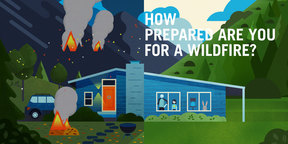
Your Home for Wildfire
Where there is
smoke, there could be fire! Wildfires can occur anywhere, any time of the
year, and destroy homes, businesses, and natural resources.
According to the National Fire
Protection Association’s Firewise Communities Program, more than
$1.9 billion was spent on wildfire suppression in 2016.
However, you can
prepare yourself, your business, and where you live in the event you may
experience a wildfire emergency. Get started by:
·
Watching the
Federal Emergency Management Agency’s wildfire animation – When the Fire
Starts.
·
Reviewing
your homeowner’s or renter’s insurance policy to ensure you have the adequate
coverage for your property and personal belongings.
·
Removing
flammable items, such as firewood piles and portable propane tanks, within 30
feet of all structures and discarding any dry or dead vegetation from up to
100 feet around your home.
·
Learning and
practicing evacuation routes from your home or business to an area that is
not affected by the wildfire. The best action to protect yourself and your
family is to evacuate early and avoid being trapped.
Wildfires can occur any time of the
year, but are especially prevalent during the dry season. Make sure you
prepare ahead of time by checking out Prepareathon's
How to Prepare for a Wildfire Guide.
|

Preparedness
for Parents
Have you heard? National
Parents’ Day is Sunday, July 23. In observance of this
occasion, we encourage family members to help parents prepare for
emergencies. Prepareathon and the Ready Campaign highlight several ways
to prepare for the unexpected.
Some of these actions include:
·
Creating a
family emergency communication plan - Your family may not
be together when disaster strikes, so it is important to plan for how
you will connect with each other.
·
Preparing infants and
young children for emergencies - Learn the emergency
plans for their daycare or school.
·
Getting
college-age kids Campus Ready
- Gather information on the emergency procedures for their school or dorm.
·
Practicing
your emergency response plan - Making emergency plans is
great, but practicing your plan by conducting drills will help your
family’s response time when seconds count.
Disasters can be stressful for kids.
Try to make emergency planning fun for children in your family. Visit www.ready.gov/kids for
exciting games, quizzes, and other resources to help young children and teens
understand the importance of emergency preparedness.
|
Preparedness
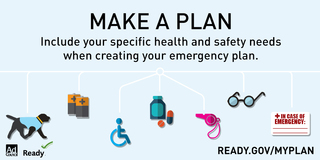
for People with Disabilities and Others with Access and Functional Needs
The 27th
anniversary of the Americans with
Disabilities Act is Wednesday, July 26. Individuals and caregivers
for people with disabilities and others with access and functional needs are
encouraged to evaluate their necessities in the event of an emergency and
create an emergency plan unique to them.
The Ready
campaign shares several easy ways to create an emergency plan tailored for
specific needs:
·
Collect
information – Create a paper copy of
the contact information including phone, email, and social media
information for your family, friends, caregivers, neighbors and other
important people or service providers.
·
Share your
emergency plans – Tell your employer and trusted
people in your support networks where you keep your emergency supplies, what
you need, and how to contact you if the power goes out.
·
Practice Your
Plan – Dedicate time to practice your
emergency plan with your support network, just as you would with a fire
drill.
For more great information on how to
make your emergency plan, visit Ready’s Individuals
with Disabilities page.
This information is from the FEMA's Individual and Community Preparedness e-Brief for July 20, 2017.
|
HSDL Critical Releases in Homeland Security [July 2017]
|
Every two weeks, the Homeland
Security Digital Library identifies a targeted collection of
recently-released documents of particular interest or potential importance.
[Login to the HSDL is necessary to open some documents.*]
|
|
·
Bad Bots: The
Weaponization of Social Media
College of William and Mary; Project on International Peace and Security
·
Big Data: A Twenty-First
Century Arms Race
Atlantic Council of the United States. Brent Scowcroft Center on International Security; Thomson Reuters
·
Fentanyl: A Briefing
Guide for First Responders
United States. Drug Enforcement Administration
·
How Do Education and
Unemployment Affect Support for Violent Extremism?: Evidence From Eight Arab
Countries
Brookings Institution. Global Economy and Development
·
How al-Qaeda Survived
Drones, Uprisings, and the Islamic State: The Nature of the Current Threat
Washington Institute for Near East Policy |
|
The Homeland Security Digital Library (HSDL) is the nation’s premier collection of homeland security policy and strategy related documents. It supports local, state and federal analysis and decision-making needs and assists academics of all disciplines in homeland defense and security related research. The HSDL provides quick access to thousands of important U.S. policy documents, presidential directives, and national strategy documents as well as specialized resources such as theses and research reports from various universities, organizations and local and state agencies. *If you received this message and do not have an HSDL account, you may request one. Those with access are automatically subscribed to Critical Releases in Homeland Security. |
Friday, July 14, 2017
Prepare your family financially for a disaster
|
Subscribe to:
Comments (Atom)