Thursday, August 23, 2018


Wednesday, August 22, 2018
Northwest Missouri Ice Storm of December 2007: Lessons Learned
 |
| Sagging power lines - Pinterest |
By John Fisher
In the ice storm of December 2007 almost 59,000 homes and
businesses were without power in the Northwest Missouri area which included the
towns of St. Joseph, Maryville, Savannah, Tarkio. Ice ranged from more than a
half-inch in St. Joseph to 2 inches farther north, said Tom Kelley, Aquila's
regional manager. More than 1 million people were without power from Oklahoma to
Illinois ("We've never...", 2008).
"From my perspective, we've never had a storm like that hit
our entire system," Kelley said. The electric utility and weather services
sent out press releases to warn people to be ready for the storm, but no one
was really prepared when the storm hit Tuesday, December 11.
At Northwest Missouri State University in Maryville 7000 students
were preparing to take exams. About 90 percent of the students were from
outside the region and were anticipating going home for the holidays. Almost
2000 students lived in campus housing, while the remainder rented apartments in
Maryville. A smaller number commuted on a daily basis.
Fortunately, at the University power never did go off. However,
classes were cancelled. It was dangerous to walk across campus, not only because
trees blocked the sidewalks, but the walkways were so icy no one could stand
up. After a couple of days highways and
roads were sanded and salted so that students could go home. In the meantime,
food supplies ran low in the town and the campus cafeteria.
 |
| Northwest Missouri State University photo |
A shelter was set up in the National Guard Armory on the west side
of campus. Guardsmen went door-to-door throughout the community and rural area checking
on people and helping those without resources, mainly older people, to move to
the shelter.
My wife and I lived in Maryville, where I taught for the university.
We never lost our telephone land-line, but our electric power was off for four
or five days. With temperatures well below freezing, the house soon became chilly
inside. We slept in our family room where we had a gas fireplace. From a call
to my wife’s brother in West Virginia, we learned how to by-pass the electric
switch in order to light the gas. We had
plenty of can goods in the basement, but didn’t have a way to cook food – not even
a camp stove. We were concerned about the food in our freezer and fridge. Thankfully,
power came back on before we had to move the freezer food outside. On the
second day, we were able to get to the campus, where members of our church
gathered for the next three or four evenings in a classroom for potlucks and movies.
The electric utility learned from a December 1994 ice storm where
15,000 homes and businesses lost power from up to a quarter-inch of ice. In
1994, the electric utility didn't appear to fully grasp the extent of the
damage on the first day, when it said they would have power on within a day. In
fact, it took six days. Aquila Light & Power brought in about 180 linemen,
most in from other area utilities.
Kelley described the 1994 response as "more reaction instead
of being ready." In 2007 the utility was somewhat better prepared.
In 2007, Aquila issued a press release in the hours leading up to
the storm that it had 90 electrical workers and 85 tree trimmers en route to
Northwest Missouri from other areas. Within three days, Aquila had 275 tree
trimmers and 667 electrical workers involved in the recovery effort in Northwest
Missouri, including 454 contract electrical workers from other companies. Still it took over a week to get power on in some areas.
The major reason for power failure is tree limbs falling on power
lines. Also, power lines sag and break because of extra weight. The electric utility has a 4-5 year rotation where they clear limbs 8
feet around power lines, mostly so trees don’t grow into the lines. This is not enough
to prevent damage from falling trees or limbs in an ice storm.
When I talked to the campus police chief afterwards, he admitted
that the University was “just plain lucky.” If power had gone off on the university
campus, if temperatures were lower, and the ice storm had been longer, conditions
could have been very bad for students and the community. University officials
had deliberated about sending students home, when they were warned about the
ice storm. They had a window of about three hours when they could have done
that on Tuesday morning, but they hesitated and their indecision meant students
would have to stay on campus for two or three more days while they waited for road
conditions to improve. As it happened, exams
were cancelled and had to be re-scheduled in the new year.
A side effect to the university was damage to the trees on campus. The Missouri State Legislature named Northwest the official state arboretum in 1993. The Northwest campus features more than 1,800 trees and more than 150 species. In the ice storm of December 2007, 40 perecnt of the trees were damaged or destroyed. Students, employees, alumni and community members purchased 275 new trees to be planted on campus (Roush, 2015; Northwest, 2018).
Lessons learned
Officials and the public generally underestimate the possible
severity of weather conditions. Typically communities are unprepared, underfunded, and
lack resources for major emergencies and disasters. In Superstorm Sandy, it
took two to three weeks for stores to reopen and utilities to get services back
online. Government officials seem to be unwilling to make the tough decisions to prepare our nation, states, and communities for disasters. Also, the public has a feeling of malaise or apathy. This won't happen to me, they say. If something does happen, the government will take care of me. They have an attitude that first responders will always there to help.
We can prepare for and mitigate to handle natural disasters like floods, wildland fires, storms, and even earthquakes, but it requires hard decisions like not building or living in the path of disasters. In the case of ice storms, we need to put all power underground or cut down all trees near power lines. Every municipality needs reserves of sand and salt and the equipment to keep roads clear and maintained. Every state, every municipality should have funds in reserves to deal with catastrophes. And they need to do a better job of working with the private sector to deal with and mitigate against disasters.
Such was the case in the ice storm of December 2007. Officials underestimated the severity of the storm. The city of
Maryville (with a permanent population of 11,000) had a budget of only $25,000 for the
entire year for street maintenance. Most of it was used in the ice storm (LeCerf, 2008). The
city has no reserves for these kind of contingencies. This is typical for other
communities and municipalities throughout the country. Reserves in terms of
money, personnel, and equipment should be available in every municipality, even
required. Training of community members (using courses like CERT) should be pushed,
because first responders cannot help everyone in major emergencies and
disasters. Debris clean-up is another
matter that has long-term impact on the people and the resources of the community.
University officials were derelict in their responsibility for
students under their care during the 2007 ice storm. Rather than focusing on the
impact of having no exams, they should have considered the possible impact of a
major ice storm on their students. Planning and exercising for these kinds of
situations would prepare university officials to make these hard decisions. Since
2007 Northwest Missouri State University has closed its cafeteria, turning food
services over to fast food vendors. The university no longer has a way of
taking care of the food needs of their students over a long period of time. Training and exercises needs to be a part of
the regular routine of staff, faculty, and students at universities and
colleges.
As a family, we were unprepared for an ice storm. Fortunately,
after four days the electrical power came back on. Had the effects of the storm lasted
longer, we would have been in trouble. While we have a food supply, we had no
water surplus; no way of cooking food, nor keeping really warm. We would have
suffered if the storm had lasted a week or even longer. As families, we need at
least three weeks of food and water on hand. We also need to have a way of keeping
warm and cooking if we have to shelter-in-place. We would do well to practice
for handling catastrophes. A three-day camp out at home in the midst of winter,
with no power or gas or water or cell phones, would be a great way to test our
resources and resiliency. A 72-hour disaster supply kit is not enough if a
disaster happens.
References
LeCerf, M. (2008, January). December Ice Storm: Overview and Clean-up
Efforts. Retrieved from http://www.maryville.org/docview.aspx?docid=28687
Roush, C. (2015, August 4). Northwest Arboretum makes "Top
50" list. Maryville Forum. Retrieved from http://www.maryvilledailyforum.com/news/article_7eeac5d0-3ab1-11e5-88ab-3b6bc32bc783.html
Northwest Missouri State University. (2018). Welcome to the
Missouri Arboretum.. Retrieved from https://www.nwmissouri.edu/arboretum/index.htm
"We've never had a storm like that": Lessons learned
from '94 storm helped shape Aquila's efforts. (2008, January 6). St. Joseph
News Press. . Retrieved from http://www.newspressnow.com/news/we-ve-never-had-a-storm-like-that/article_199dda26-f34e-52de-b951-6da4666287aa.html
Thursday, August 02, 2018
Can a tsunami hit America?
 |
| Tsunami map in Seaside, Oregon |
Thursday, June 07, 2018

Wednesday, June 06, 2018
Humanitarian Relief Core Standards
By Wesley Lefevre

Here are some questions you can ask yourself when evaluating an infographic.
Why use an Infographic?
What message doe the infographic communicate? Does it communicate the message effectively? To communicate a message.
Does it present large amounts of information in a compact and easy to understand way?
Does it reveal the data, discover cause-effect relations, and identify relationships among data?
Does it help monitor and show changes or trends in data?
What message doe the infographic communicate? Does it communicate the message effectively? To communicate a message.
Does it present large amounts of information in a compact and easy to understand way?
Does it reveal the data, discover cause-effect relations, and identify relationships among data?
Does it help monitor and show changes or trends in data?
Discussion questions
What is useful about putting information in this format?
Why would this be better than just showing the formulas or using just a bar graph?
What different pieces of information are included on this poster?
What information was included in this poster that allows lay people to understand the content?
Write an abstract about what it is about (two or three sentences that highlights the purpose of the infographic.)
What is useful about putting information in this format?
Why would this be better than just showing the formulas or using just a bar graph?
What different pieces of information are included on this poster?
What information was included in this poster that allows lay people to understand the content?
Write an abstract about what it is about (two or three sentences that highlights the purpose of the infographic.)
Consider the following for each:
Look at these examples and identify what you like/don't like about each one.
How are colors used differently in each one? Are some colors more powerful than others?
How are objects displayed on each one? Do sizes of the objects matter in showing the intended information?
How could colors, sizes, and kinds of objects be used to mislead people away from the data?
Make notes about what you notice and like/don't like about the infographics. These notes will remind you of what you visually like to see and will serve as a starting point for you.
Look at these examples and identify what you like/don't like about each one.
How are colors used differently in each one? Are some colors more powerful than others?
How are objects displayed on each one? Do sizes of the objects matter in showing the intended information?
How could colors, sizes, and kinds of objects be used to mislead people away from the data?
Make notes about what you notice and like/don't like about the infographics. These notes will remind you of what you visually like to see and will serve as a starting point for you.
References:
Evaluating Infographics. (2018). Retrieved from http://room233.wikispaces.com/Evaluating+Infographics

Tuesday, February 20, 2018
New Associate with the Institute of Emergency Services and Homeland Security
 |
| Dr. Iryna Vyshnevska-Cherkas |
Dr. Vyshnevska-Cherkas serves as a diplomat at the Ukrainian Embassy in Norway. She has a PhD (2015) from the Institute of International Relations, Kyiv National Taras Shevchenko University. She authored the book “USA-China: congagement strategy” (Kyiv, 2016), and was co-author of the book “The foreign policy of the Russian Federation: Selected aspects of relations with Poland, Ukraine and Belarus” (Krakow, 2010) and has written more than 80 scientific publications in Ukrainian and foreign editions. She previously worked as a diplomat in the NATO division of the Directorate General for International Security, Ministry of Foreign Affairs of Ukraine.
Advancing her knowledge and skills, Iryna studied at the Swedish National Defence College (Stockholm), NATO School in Oberammergau (Germany), Royal Military Academy in Brussels (Belgium), and Peace Support Operations Training Centre – Partnership Training and Education Centre in Sarajevo (Bosnia and Herzegovina).
Friday, February 16, 2018

Wednesday, February 07, 2018
UVU students meet Macedonian firefighters
 |
| UVU Students with members of the Struga, Macedonia fire department |
Saturday, January 20, 2018
Monday, January 08, 2018
Cyber Storm VI: National Cyber Exercise
The Cyber Storm exercise series is the Department of Homeland Security’s (DHS) national, biennial distributed exercise entirely focused on cyber incident response. Mandated by Congress, these exercises are part of the Department’s ongoing efforts to assess and strengthen cyber preparedness, examine incident response processes, and enhance information sharing among federal, state, international, and private sector partners. Each Cyber Storm event builds on lessons learned from previous exercises and real world incidents, ensuring that participants address relevant and timely challenges.
Cyber Storm exercises give the cyber incident response community a safe venue to coordinate and practice plans, response mechanisms and recovery tasks, as well as to build and maintain relationships. Most importantly, the exercises provide the community with the opportunity to identify strengths and areas for improvement, incorporating those lessons into operations to help reduce cyber risks to the nation.
The high-level objectives of Cyber Storm VI include:
Cyber Storm VI is scheduled for Spring 2018. The exercise will focus on the critical manufacturing and transportation sectors, with participation from the information technology and communications sectors; law enforcement, defense, and intelligence agencies; state, local, and territorial governments; and international partners. For more information, email cyberstorm@hq.dhs.gov.
To review the final reports from previous Cyber Storm exercises, visit https://www.dhs.gov/publication/cyber-storm-final-reports.
Thursday, August 17, 2017
Public sentiment and discourse about Zika virus on Instagram
 |
| The Aedes aegypti mosquito spreads the Zika virus, as well as dengue fever and chikungunya. |
Instagram can be used to identify incorrect information
about health issues and help health professionals correct misleading or incomplete
information. University of Pennsylvania researchers in the September 2017 issue
of Public Health showed how using keywords or hashtags public health
professionals can get real-time information about public preparedness and
response to diseases.
The researchers used the keyword #zika to identify 500
images posted on Instagram from May to August 2016 about public sentiment on
the Zika outbreak. They found that 60% of relevant posts included misleading,
incomplete or unclear information about the virus and many images (51%)
expressed fear and negative sentiment.
Of the 500 images tagged with #zika, 342 (68%) contained
content actually related to Zika. Of the 342 images, 299 were coded as ‘health”
and 193 were coded as ‘public interest’.
Health images related mainly to transmission (43%) and prevention
(48%). Transmission-related posts were more about mosquito-to-human
transmission rather than human-to-human transmission. Mosquito bite prevention
was more of a concern than safe sex prevention. The most targeted audience were
women (36 of 38 images).
Images were coded by three reviewers who collected
contextual information about sentiment, image type, content, audience,
geography, reliability and engagement.
Reference: Seltzer, E.K., E. Horst-Martz, M. Lu, R.M.
Merchant. (2017). Public sentiment and discourse about Zika virus on Instagram.
Public Health. Vol. 150, pp. 170-175.
DOI: http://dx.doi.org/10.1016/j.puhe.2017.07.015 Retrieved from http://www.publichealthjrnl.com/article/S0033-3506(17)30244-5/abstract
Source: http://www.cbc.ca/news/world/zika-virus-what-canadians-travellers-need-to-know-1.3424064
 |
Friday, July 21, 2017
Preparedness tips for a wildfire and for people with disabilities
Prepare
Your Home for Wildfire
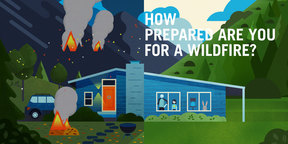 Where there is
smoke, there could be fire! Wildfires can occur anywhere, any time of the
year, and destroy homes, businesses, and natural resources. Where there is
smoke, there could be fire! Wildfires can occur anywhere, any time of the
year, and destroy homes, businesses, and natural resources.
According to the National Fire
Protection Association’s Firewise Communities Program, more than
$1.9 billion was spent on wildfire suppression in 2016.
However, you can
prepare yourself, your business, and where you live in the event you may
experience a wildfire emergency. Get started by:
·
Watching the
Federal Emergency Management Agency’s wildfire animation – When the Fire
Starts.
·
Reviewing
your homeowner’s or renter’s insurance policy to ensure you have the adequate
coverage for your property and personal belongings.
·
Removing
flammable items, such as firewood piles and portable propane tanks, within 30
feet of all structures and discarding any dry or dead vegetation from up to
100 feet around your home.
·
Learning and
practicing evacuation routes from your home or business to an area that is
not affected by the wildfire. The best action to protect yourself and your
family is to evacuate early and avoid being trapped.
Wildfires can occur any time of the
year, but are especially prevalent during the dry season. Make sure you
prepare ahead of time by checking out Prepareathon's
How to Prepare for a Wildfire Guide.
|
 |
Preparedness
for Parents
 Have you heard? National
Parents’ Day is Sunday, July 23. In observance of this
occasion, we encourage family members to help parents prepare for
emergencies. Prepareathon and the Ready Campaign highlight several ways
to prepare for the unexpected. Have you heard? National
Parents’ Day is Sunday, July 23. In observance of this
occasion, we encourage family members to help parents prepare for
emergencies. Prepareathon and the Ready Campaign highlight several ways
to prepare for the unexpected.
Some of these actions include:
·
Creating a
family emergency communication plan - Your family may not
be together when disaster strikes, so it is important to plan for how
you will connect with each other.
·
Preparing infants and
young children for emergencies - Learn the emergency
plans for their daycare or school.
·
Getting
college-age kids Campus Ready
- Gather information on the emergency procedures for their school or dorm.
·
Practicing
your emergency response plan - Making emergency plans is
great, but practicing your plan by conducting drills will help your
family’s response time when seconds count.
Disasters can be stressful for kids.
Try to make emergency planning fun for children in your family. Visit www.ready.gov/kids for
exciting games, quizzes, and other resources to help young children and teens
understand the importance of emergency preparedness.
|
|
Preparedness
for People with Disabilities and Others with Access and Functional Needs
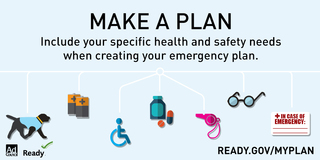 The 27th
anniversary of the Americans with
Disabilities Act is Wednesday, July 26. Individuals and caregivers
for people with disabilities and others with access and functional needs are
encouraged to evaluate their necessities in the event of an emergency and
create an emergency plan unique to them. The 27th
anniversary of the Americans with
Disabilities Act is Wednesday, July 26. Individuals and caregivers
for people with disabilities and others with access and functional needs are
encouraged to evaluate their necessities in the event of an emergency and
create an emergency plan unique to them.
The Ready
campaign shares several easy ways to create an emergency plan tailored for
specific needs:
·
Collect
information – Create a paper copy of
the contact information including phone, email, and social media
information for your family, friends, caregivers, neighbors and other
important people or service providers.
·
Share your
emergency plans – Tell your employer and trusted
people in your support networks where you keep your emergency supplies, what
you need, and how to contact you if the power goes out.
·
Practice Your
Plan – Dedicate time to practice your
emergency plan with your support network, just as you would with a fire
drill.
For more great information on how to
make your emergency plan, visit Ready’s Individuals
with Disabilities page.
This information is from the FEMA's Individual and Community Preparedness e-Brief for July 20, 2017.
|
HSDL Critical Releases in Homeland Security [July 2017]
|
Every two weeks, the Homeland
Security Digital Library identifies a targeted collection of
recently-released documents of particular interest or potential importance.
[Login to the HSDL is necessary to open some documents.*]
|
|
·
Bad Bots: The
Weaponization of Social Media
College of William and Mary; Project on International Peace and Security
·
Big Data: A Twenty-First
Century Arms Race
Atlantic Council of the United States. Brent Scowcroft Center on International Security; Thomson Reuters
·
Fentanyl: A Briefing
Guide for First Responders
United States. Drug Enforcement Administration
·
How Do Education and
Unemployment Affect Support for Violent Extremism?: Evidence From Eight Arab
Countries
Brookings Institution. Global Economy and Development
·
How al-Qaeda Survived
Drones, Uprisings, and the Islamic State: The Nature of the Current Threat
Washington Institute for Near East Policy |
|
The Homeland Security Digital Library (HSDL) is the nation’s premier collection of homeland security policy and strategy related documents. It supports local, state and federal analysis and decision-making needs and assists academics of all disciplines in homeland defense and security related research. The HSDL provides quick access to thousands of important U.S. policy documents, presidential directives, and national strategy documents as well as specialized resources such as theses and research reports from various universities, organizations and local and state agencies. *If you received this message and do not have an HSDL account, you may request one. Those with access are automatically subscribed to Critical Releases in Homeland Security. |
Friday, July 14, 2017
Prepare your family financially for a disaster
|



Subscribe to:
Comments (Atom)