Friday, July 21, 2017

Preparedness tips for a wildfire and for people with disabilities

Prepare Your Home for Wildfire
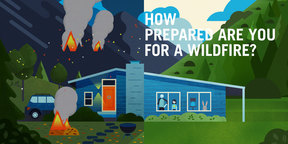
How Prepared Are You For WildfireWhere there is smoke, there could be fire! Wildfires can occur anywhere, any time of the year, and destroy homes, businesses, and natural resources.

According to the National Fire Protection Association’s Firewise Communities Program, more than $1.9 billion was spent on wildfire suppression in 2016.

·         Watching the Federal Emergency Management Agency’s wildfire animation – When the Fire Starts.
·         Reviewing your homeowner’s or renter’s insurance policy to ensure you have the adequate coverage for your property and personal belongings.
·         Removing flammable items, such as firewood piles and portable propane tanks, within 30 feet of all structures and discarding any dry or dead vegetation from up to 100 feet around your home.
·         Learning and practicing evacuation routes from your home or business to an area that is not affected by the wildfire. The best action to protect yourself and your family is to evacuate early and avoid being trapped.  

Wildfires can occur any time of the year, but are especially prevalent during the dry season. Make sure you prepare ahead of time by checking out Prepareathon's How to Prepare for a Wildfire Guide.


Preparedness for Parents

Family Fills Out Emergency PlanHave you heard? National Parents’ Day is Sunday, July 23. In observance of this occasion, we encourage family members to help parents prepare for emergencies. Prepareathon and the Ready Campaign highlight several ways to prepare for the unexpected.

Some of these actions include: 
·         Creating a family emergency communication plan - Your family may not be together when disaster strikes, so it is important to plan for how you will connect with each other.
·         Preparing infants and young children for emergencies - Learn the emergency plans for their daycare or school.
·         Getting college-age kids Campus Ready - Gather information on the emergency procedures for their school or dorm.
·         Practicing your emergency response plan - Making emergency plans is great, but practicing your plan by conducting drills will help your family’s response time when seconds count. 

Disasters can be stressful for kids. Try to make emergency planning fun for children in your family. Visit www.ready.gov/kids for exciting games, quizzes, and other resources to help young children and teens understand the importance of emergency preparedness. 


Preparedness for People with Disabilities and Others with Access and Functional Needs
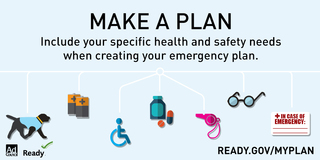

Make an Emergency PlanThe 27th anniversary of the Americans with Disabilities Act is Wednesday, July 26. Individuals and caregivers for people with disabilities and others with access and functional needs are encouraged to evaluate their necessities in the event of an emergency and create an emergency plan unique to them.

The Ready campaign shares several easy ways to create an emergency plan tailored for specific needs:
·         Collect information – Create a paper copy of the contact information including phone, email, and social media information for your family, friends, caregivers, neighbors and other important people or service providers.
·         Share your emergency plans – Tell your employer and trusted people in your support networks where you keep your emergency supplies, what you need, and how to contact you if the power goes out.
·         Practice Your Plan – Dedicate time to practice your emergency plan with your support network, just as you would with a fire drill.

For more great information on how to make your emergency plan, visit Ready’s Individuals with Disabilities page. 

This information is from the FEMA's Individual and Community Preparedness e-Brief  for July 20, 2017.

HSDL Critical Releases in Homeland Security [July 2017]

Every two weeks, the Homeland Security Digital Library identifies a targeted collection of recently-released documents of particular interest or potential importance. [Login to the HSDL is necessary to open some documents.*]
·         Bad Bots: The Weaponization of Social Media
College of William and Mary; Project on International Peace and Security

·         Big Data: A Twenty-First Century Arms Race
Atlantic Council of the United States. Brent Scowcroft Center on International Security; Thomson Reuters

·         Fentanyl: A Briefing Guide for First Responders
United States. Drug Enforcement Administration

·         How Do Education and Unemployment Affect Support for Violent Extremism?: Evidence From Eight Arab Countries
Brookings Institution. Global Economy and Development


The Homeland Security Digital Library (HSDL) is the nation’s premier collection of homeland security policy and strategy related documents. It supports local, state and federal analysis and decision-making needs and assists academics of all disciplines in homeland defense and security related research. The HSDL provides quick access to thousands of important U.S. policy documents, presidential directives, and national strategy documents as well as specialized resources such as theses and research reports from various universities, organizations and local and state agencies.

*If you received this message and do not have an HSDL account, you may request one. Those with access are automatically subscribed to Critical Releases in Homeland Security.

Friday, July 14, 2017

Prepare your family financially for a disaster


Is Your Family Financially Prepared for a Natural Disaster?

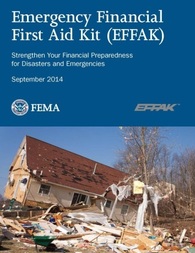
Emergency Financial First Aid KitDeveloping plans and participating in drills are essential emergency preparedness activities. Taking steps to be financially prepared for an emergency is a critical activity in any planning effort.

The Emergency Financial First Aid Kit (EFFAK), a joint publication from Operation Hope, and the Federal Emergency Management Agency, contains information for you to prepare now for a financial emergency. The guide includes information on obtaining insurance, planning tips and resources to help you manage your finances, and accessing important records to help you recover more quickly should you be affected by a disaster.

Financial Preparedness Resources
·         The EFFAK in EnglishSpanish, and a reader enabled English version that is fillable online. (2015 version)
·         An EFFAK overview slide presentation in English and Spanish.
·         EFFAK checklists and forms in standard and reader enabled/fillable versions.
·         Find out how prepared you are with the Disaster Financial Recovery Score from Operation Hope.

Financial preparedness is one of the many ways to participate in Prepareathon. Register your preparedness actions today at www.ready.gov/prepare.


Get Tech Ready

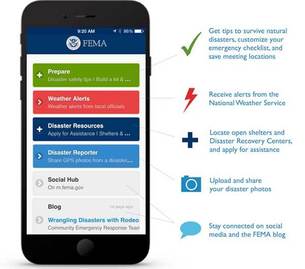
FEMA App FeaturesHow would you find out if there was an alert in your area? While watching television or listening to the radio may be effective, mobile technology and the Internet have become one of the quickest and most popular ways for Americans to receive emergency information instantly. 

Smartphone alerts and warning apps can make it easier than ever for families, businesses, and individuals to effectively prepare for and recover from disasters. Visit the Ready Campaign’s Get Tech Ready page for tips, such as:
·         Sign up to receive preparedness tips from the Federal Emergency Management Agency’s (FEMA) text message program: text PREPARE to 43362 (4FEMA).
·         Download the FEMA App to access disaster preparedness tips, obtain weather alerts for up to five locations, and look for open Disaster Recovery Centers along with open shelters. 
·         Store your important documents such as personal and financial records on a secure flash or jump drive that you can keep readily available.

Take care of yourself and your loved ones by having preparedness at your fingertips. Learn more at www.ready.gov/get-tech-ready.  


Prepare for Flash Flooding

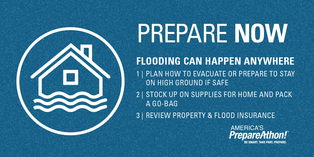
Prepare Now. Flooding Can Happen Anywhere.Flash floods happen quickly; it is important to recognize whether or not you live in an area prone to flash flooding and how you can prepare in advance.

According to the National Weather Service, the causes of flash flooding include heavy rain, ice or debris jams, and levee or dam failure. These floods exhibit a rapid rise of water over low-lying areas. In some cases, flooding may even occur away from where heavy rain initially fell.

Follow these tips from Ready.gov to make sure you, your family, and your home are prepared for a flash flood:
·         Know your flood risk.
·         Make a flood emergency plan.
·         Consider buying flood insurance.
·         Familiarize yourself with local emergency plans. Know where to go and how to get there should you need to get to higher ground, the highest level of a building, or to evacuate.
·         Stay tuned to your phone alerts, TV, or radio for weather updates, emergency instructions, or evacuation orders.

For more flood safety information, download Prepareathon’s How to Prepare for a Flood guide.


Important Dates to Remember

·         July 31-August 1: Campus Safety Conference West
·         August 1: National Night Out


Disclaimer: The reader recognizes that the federal government provides links and informational data on various disaster preparedness resources and events and does not endorse any non-federal events, entities, organizations, services, or products. Please let us know about other events and services for individual and community preparedness that could be included in future newsletters by contacting citizencorps@fema.dhs.gov.

Tuesday, June 27, 2017

Friday, March 24, 2017

Wednesday, February 22, 2017

Monday, February 20, 2017

Wednesday, September 28, 2016

Chief Jarrod Burguan - Press Conference

San Bernardino shootings news coverage

Los Angeles radio reporter Steve Gregory (iHeartMedia/KFI AM 640) got his first tips of a possible shooting at the San Bernardino Inland Regional Center about 10 minutes after the shooting occurred. He started to drive toward the area, making calls and texting to verify that an incident was happening.

His calls to the San Bernardino police were unanswered. In the meantime people were calling into the talk show at his station and the social media was a buzz. He arrived north of the Center and got out looking for the staging area for reporters. As he stood there with other journalists, behind a California State Police line, people started walking by toward buses. "Don't talk to reporters," they were told by police escorts.

In the meantime, Jarrod Burguan, chief of the San Bernardino police department, and every available police officer were at the conference rooms of the Inland Regional Center. What they saw was a scene of carnage with  14 dead and 22 wounded county government employees who had been attending a training and early Christmas party. The perpetrators, two hooded people, had fired 100 rounds from two guns in three minutes. 

At about 11 a.m. 9-1-1 calls started coming into the police dispatch center saying people had been shot. Because of the absence of the regular PIO, Chief Burguan assigned the deputy PIO, a traffic sergeant to handle the press. They established a staging area for reporters south of the Inland Regional Center. 

The sergeant starting taking reporter questions, most of which she couldn't answer. As she got radio reports and phone calls, she was able to provide sketchy details of the incident. More details about the incident were made available at a press conference held about 1 p.m., attended by Chief Burguan, the county sheriff, and representatives of the FBI and ATF. Burguan patiently answered reporter questions, repeating details several times as new reporters arrived on the scene. Regular press conferences were held throughout the day. 

When Steve Gregory discovered he had gone to the wrong end of the crime scene, he worked his way around the area arriving just in time for the first press conference. 

In the first hours of the shooting, police dispatchers received 300 calls an hour.  Two were answering phone calls and two others were handling the police radio. One of the calls led to the identification of the suspects car, a dark SUV rental with Utah plates. 

Thirty to 40 police had responded to the scene. In cooperation with other agencies, they searched the buildings associated with the center and helped vacate some 200 county employees who worked there. Firefighters and paramedics and other health care treated and transported the wounded. 

Buses were called and employees were moved to a central location for questioning and family reunion.

The suspects were soon identified. One was Syed Farook was a county employee who had attended the training, but left at about 10:30 a.m. A SWAT team went to his home in Redlands, using cell phones so that their movements couldn't be traced on police radios.  


Case Study: Journalists invade home of terrorist suspects

LA Times photo of journalists inside the home of Syed Farook
Scott Collins of the Los Angeles Times describes how on Friday, December 4, 2015, over 100 journalists invaded the home of Syed Farook and his wife, Tashfeen Malik, the suspected perpetrators of the San Bernardino terrorist attack.

The invasion was seen on live television. And was soon criticized.

"You have a contaminated crime scene now," CNN legal analyst Paul Callan told host Wolf Blitzer. "They've turned a crime scene in a terrorist mass murder into a garage sale." In a suitably weird twist, states Collins, at the moment of the criticism CNN was airing a split screen with footage from inside the home, showing laundry baskets, documents, toys and other personal effects.

Questions for study: As the police department PIO, what would you do in this situation? How can you provide journalists coverage while protecting the integrity of the crime scene?

Source: Collins, Scott. (2015, December 4). Media criticized for live TV coverage from home of San Bernardino shooters. Los Angeles Times online. Retrieved from
http://www.latimes.com/entertainment/tv/showtracker/la-et-st-media-coverage-home-san-bernardino-shooting-shooters-20151204-story.html 

Tuesday, August 02, 2016

Managing Life-and-Death Situations

With an emergency management plan in place, Iowa Gov. Tom Vilsack was prepared when tornadoes hit in 1999. (AP)
When former Iowa Gov. Tom Vilsack was about to take office in 1999, he went to the National Governors Association’s New Governor’s School, and sat next to then-Gov. Zell Miller of Georgia. Vilsack had one big question to ask his seatmate: “What are the one or two things I should focus on? Should it be health care? Jobs? Education?”

As Vilsack recalls, “Gov. Miller said, ‘Son, emergency management. I guarantee you that within six months something is going to happen in your state and if you don’t handle it well, it won’t make any damn difference what you do in health care or jobs or education.”  Read the rest of the article. 

The stunning fall of Debbie Wasserman Schultz

Cyber Terrorism Roles Clarified

Members of the Democratic Party are accusing the Russians of hacking into DNC party emails and releasing them in order to discredit candidate Clinton in support of Trump.

Clinton’s campaign chief, Robby Mook, told ABC News that “experts are telling us that Russian state actors broke in to the DNC, took all these emails and now are leaking them out through these Web sites. . . . It’s troubling that some experts are now telling us that this was done by the Russians for the purpose of helping Donald Trump.”

Russians hack DNC emails? Do they favor Donald over Hillary?
The accusations appear on the surface to be wild and politically motivated. (Why would the Russians want Trump more than Hillary?) However, the real possibility exists that foreign governments could perform cyber attacks to interfere in U.S. politics. Other more serious threats would be hacking the U.S. Treasury payroll and government personnel records. (Oops! That has already happened.) Or worse attacks on U.S. infrastructure which would cause havoc or stoppage to transportation and utilities. (That may have already happened as well.)

On July 26, 2016 the White House issued Presidential Policy Directive PPD-41 on United States Cyber Incident Coordination to deal specifically with these kinds of threats. The directive indicates which agency handles what and reveals how the administration grades the severity of an event, determining what is significant.

The FBI will be the lead federal agency investigating criminal and national security hacks. The Department of Homeland Security will help organizations reduce the impact of an event and prevent its spread, mainly through preparedness and prevention. The Cyber Threat Intelligence Integration Center, or CTIIC, will gather intelligence to help identify who directed an intrusion or attack. Because the Defense Department does not play a primary role in domestic cybersecurity, it is not mentioned in the directive.

All this has potential for some great spy novels and action movies. It's good to have the roles clarified so we know who the actors will be.

See Presidential Policy Directive PPD-41.
  

Monday, August 01, 2016

Wildfire Evacuation Plans


WildfireIf a wildfire was headed your way, would you know what to do? According to America’s PrepareAthon! the best action to protect yourself and your family when a wildfire threatens your area is to evacuate.
 
To ensure you will be able to evacuate quickly, you need to plan ahead. America’s PrepareAthon! offers these tips for a safe evacuation, including:
·         Know your community’s local evacuation plan and identify several escape routes for your location in case roads are blocked; include plans to evacuate people with disabilities and others with access or functional needs, as well as pets, service animals, and livestock;
·         Make a list of items you need or want to take with you. Be sure to remember the Five P’s Of Evacuation: People, Prescriptions, Papers, Personal Needs, and Priceless Items; and
·         If you will evacuate by car, keep your car fueled and in good condition. Keep emergency supplies and a change of clothes in your car. 
When driving away from a fire:
·         Roll up windows and close air vents because smoke from a fire can irritate your eyes and respiratory system;
·         Drive slowly with your headlights on because smoke can reduce visibility;
·         Watch for other vehicles, pedestrians, and fleeing animals; and
·         Avoid driving through heavy smoke, if possible. 
For more information about preparing for wildfires, download the How to Prepare for a Wildfire guide from America’s PrepareAthon!
The FEMA app is another great resource to help you prepare for wildfires and other hazards.  Download the FEMA app today to receive safety reminders, alerts from the National Weather Service, and more!

From FEMA's Individual and Community Preparedness e-Brief, July 28, 2016. Provide other events and services for individual and community preparedness that could be included in future newsletters by contacting citizencorps@fema.dhs.gov